Monthly & annual budgeting
Monthly vs Annual Budgeting: Why You Need Both, and How to Connect Them to Payday
Ask three people what a budget is and you will get three time frames. One means the month: rent, groceries, what is left on the 25th. One means the year: the insurance renewal, the holiday, whether savings went up. One means the paycheck: what has to come out of Friday's deposit before it is safe to spend. All three are right, and most budgeting tools make you pick one.
You do not have to pick. The three frames answer different questions, and a budget that connects them answers all of them from the same numbers.
The month: where spending happens
The monthly view is the working budget. Income for the month, bills with their dates, categories with planned and actual amounts, and a ledger of what was spent. This is the frame you open most often, because it is where the small decisions live: is there room for takeaway on Thursday, did the phone bill go out, are groceries running hot.
Its weakness is horizon. From inside September you cannot see that November holds the insurance renewal and December holds gifts, and that together they are more than a normal month can absorb.
The year: where the spikes hide
The annual view lays twelve months side by side, and the spikes become visible as spikes: rows that are flat for ten months and tall for two. Once you can see them, you can flatten them. A $960 insurance bill in November becomes an $80 line in every month, saved into a fund that pays the bill when it comes. The year view is where sinking funds get designed; the month view is where they get funded.
The year also holds the answers to slower questions. Is net worth moving? Did the savings rate improve on last year? Which quarter went wrong? None of those are visible from a single month.
Payday: when the money actually arrives
Here is the frame most budgets ignore. Bills are monthly; income is weekly, biweekly or twice a month. A monthly plan that says "rent $1,400, income $3,600" is true and useless on the 3rd of the month if the check that covers rent does not land until the 14th.
Mapping the month's obligations onto real paydays fixes this. Each bill is assigned to the check that funds it, or pulled to the one before if the timing is tight. Dated goals, the fund that needs $400 by March, get per-check suggestions: "put $57 from each of the next seven checks." Now the month's plan and the year's funds are both expressed in the one unit that matches the bank: the deposit.
What connects the three
One set of numbers. The year grid's plan for a month is the month view's plan. The month view's bills are what the paycheck view assigns to checks. A fund designed in the year view is funded from specific checks in the paycheck view and shows its balance in the month. Change a number in any frame and the other two reflect it, because there is only one number.
The one thing a connected budget must never do is pretend. Planned leftover, the money the plan says should remain at month end, is a forecast. It is not your bank balance, and a budget that shows it as if it were will be wrong on the first day something unplanned happens. Keep planned leftover clearly separate from variable spending, and label it as an estimate, every time.
Where the app comes in
The Annual & Monthly Budget Planner holds all three frames. An editable twelve-month grid with planned, actual and difference layers, where manual plans override bill and fund automation and category defaults; a monthly ledger with linked bill payments, recurring entries and bank CSV import; and an optional paycheck lens that generates real paydays for one or two income schedules, weekly, biweekly, twice-monthly or monthly, with weekend-to-Friday handling, maps bills to their containing check or one or two earlier, and suggests per-check amounts for dated funds and annual or quarterly obligations. Planned leftover is kept clearly separate from variable spending. It runs offline with net worth tracking and a printable Year in Review.
Frequently asked questions
Is this overkill for a simple household?
If you are paid monthly and have no large annual bills, a monthly budget alone is fine. The moment you have a biweekly paycheck or an insurance renewal that hurts, the other two frames start earning their keep.
Do I have to use the paycheck view?
No. It is a lens over the same numbers, not a separate budget. Some people switch it on only in months where the timing is tight.
What is "planned leftover" and why is it separate?
It is what the plan says should remain after all planned income and spending. It is a forecast, not cash in hand, so the budget keeps it apart from the variable spending you are actually doing, and never presents it as a bank balance.
Keep reading
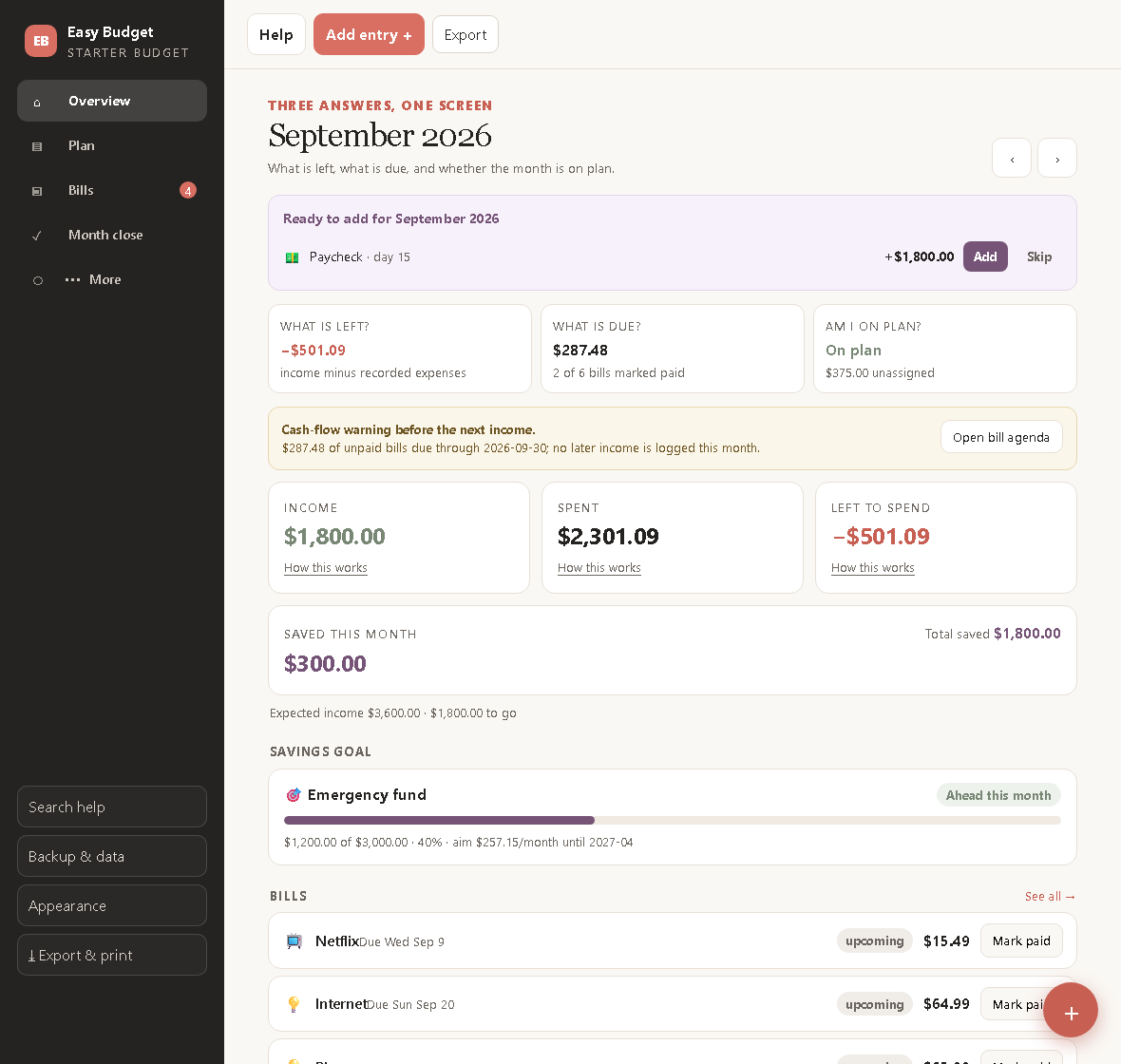
How to Make Your First Budget in Twenty Minutes
A beginner's budget with only three parts, bills, a plan and one goal, and the three questions it should answer every time you open it.
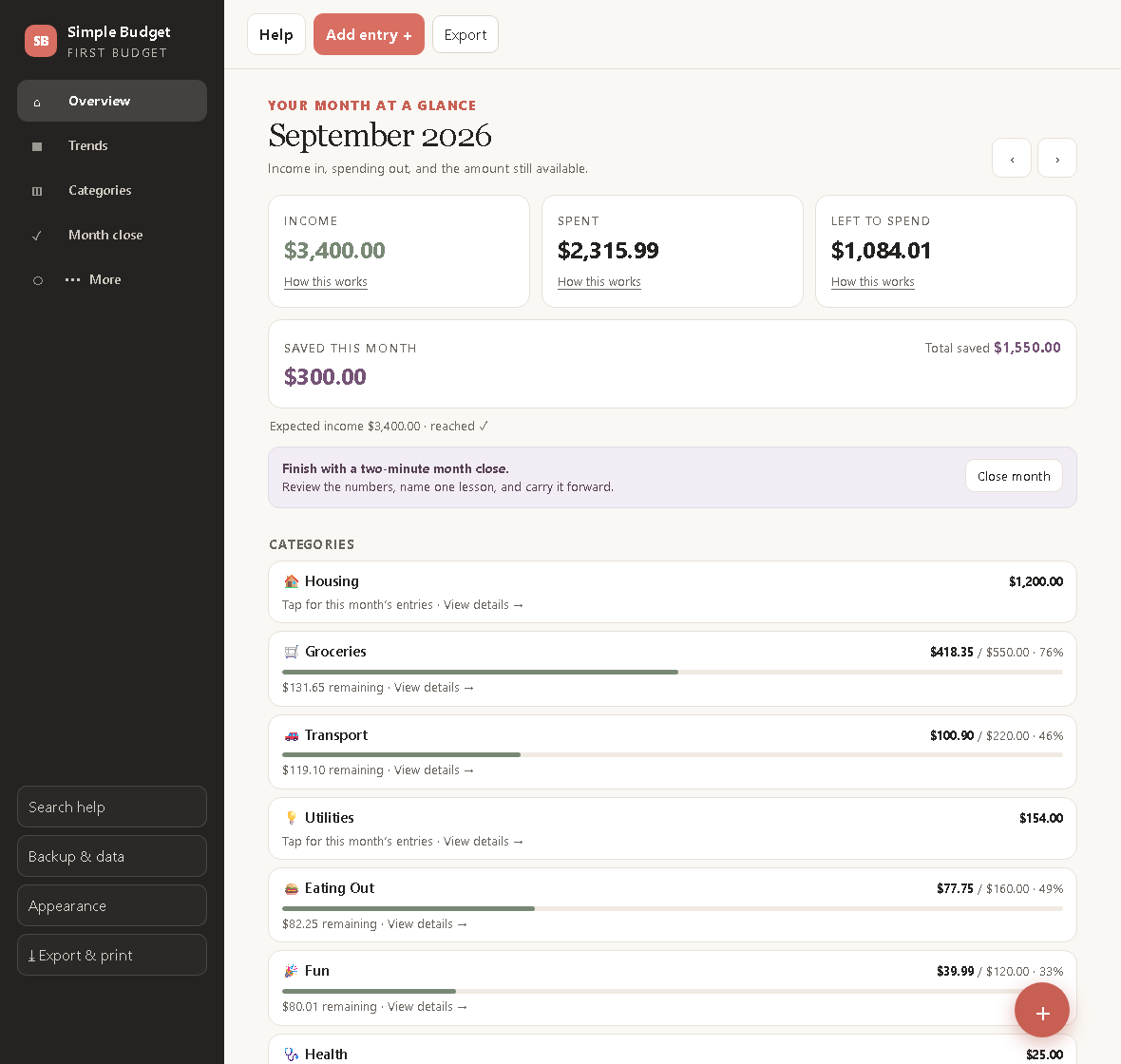
The Ten-Minute Budget: A Free, Simple Way to Start
A budget you can set up in ten minutes and keep in two minutes a month. Income, expenses, one savings line, and a close that takes less time than a coffee.
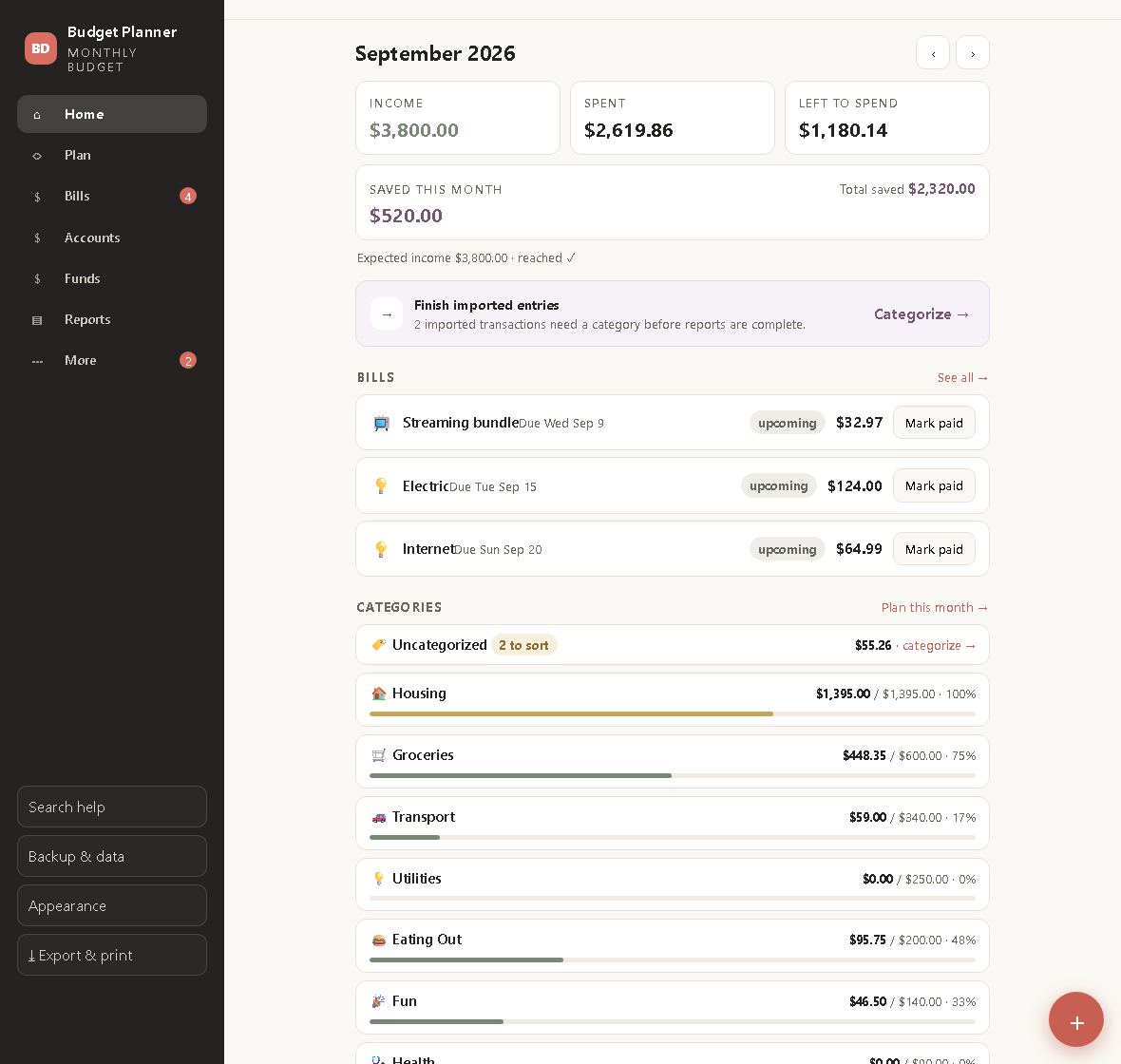
Reconcile Your Budget Every Month: The Habit That Makes Budgets Stick
Why a budget drifts from your bank balance, how to reconcile it in fifteen minutes, and how sinking funds keep annual bills from wrecking a month.