Productivity & ADHD
The 1-3-5 Method: Plan a Day You Can Actually Run
A to-do list is a wish. A plan is a wish with a time attached. Most days go wrong in the gap between the two: the list had fifteen items, the day had six hours, and nobody did the subtraction until it was 5 p.m.
The 1-3-5 method does the subtraction first.
One, three, five
Each day gets nine slots and no more:
- One must. The thing that, if it is the only thing that happens, makes the day a success.
- Three shoulds. Important, not urgent, the work that moves things forward.
- Five coulds. Small items, quick wins, the things that fit into gaps.
The limits are hard. A second must is not a must; it is a should that you are anxious about. A sixth could is tomorrow's could. The discipline of choosing is the method; the slots just make the choice visible.
Put the nine into time
Nine tasks selected is still a list. Put them on the day. The must gets the best block, usually the first uninterrupted stretch of the morning. The shoulds get blocks of their own. The coulds live in the gaps between meetings.
Time blocking exposes the lie fast: if the must needs three hours and the calendar has two, the plan is wrong on paper at 8 a.m. instead of in reality at 4 p.m. A block that would collide with another, or fall outside the work window, should be refused, and an auto-place that drops a task into the earliest gap that fits removes the fiddling.
The capacity meter
The most useful number in daily planning is the one almost no planner shows: how much of today is already spoken for. Count the blocks, count the selected work that has not been placed yet, add them up against the work window, and show the result as a gauge. Green means the day fits. Red means something has to move, now, while moving it is cheap.
The meter must not double-count. A task that is linked to a block is one thing, not two. Get that wrong and the gauge screams red on days that are fine.
Projects: ordered outcomes, one next action
A project is not a folder of tasks. It is an ordered list of outcomes, each with a visible next action, and a progress figure that means something because the outcomes were written down in advance. The next action is what gets pulled into Today. The rest stays in the project where it belongs.
Capture, then triage
Ideas and requests arrive all day. A capture inbox with a single keystroke takes them without breaking the block you are in. Triage happens at the end of the day or the start of the next: Today, Someday, a date, a project, a habit, or Drop. One tap each.
The weekly scorecard measures two different things
At the end of the week, the question is not "how much did I do?" but two questions that are usually conflated:
- Work completed. Tasks finished, deep-work blocks actually done (not planned: done).
- Promises kept. Of the things you planned, how many happened? Your must rate, your planned-hit rate, your habits.
A week with a lot of output and a low promise rate is a week you got busy instead of doing what you said. A week with a high promise rate and modest output is a week you planned honestly. Both are useful to know, and only the second one improves planning.
Freeze the week with a short reflection so next week's version cannot rewrite it.
Where the app comes in
The Productivity Planner runs this method: a selected-date 1-3-5 planner with hard limits of one must, three shoulds and five coulds; time blocking with work-window validation, conflict review, done and skipped states and earliest-gap auto-place; a capacity meter that counts blocks and unplaced selected work without double-counting linked tasks; ordered project outcomes with exact progress and a visible next action; a capture inbox with an N shortcut and one-tap triage; recurring tasks that never stack; sustainable habits with partial credit and rest passes; and a weekly scorecard that separates completed tasks and deep work from must rate and planned hits, frozen with its reflection. Guided setup is optional, and it runs offline with complete JSON recovery.
Frequently asked questions
What if my job is mostly reacting to other people?
Shrink the numbers. One must, one should, three coulds, and a large block labelled "reactive" so the capacity meter tells the truth about how much of the day is yours.
How is this different from a plain to-do list with priorities?
The caps and the time. A priority list still lets you carry thirty items; 1-3-5 refuses the tenth. And a list has no capacity; a blocked day does.
Should I plan the night before or in the morning?
The night before, if you can. Choosing nine things is a decision, and decisions are cheaper at 6 p.m. than at 8 a.m. with the inbox already open.
Keep reading
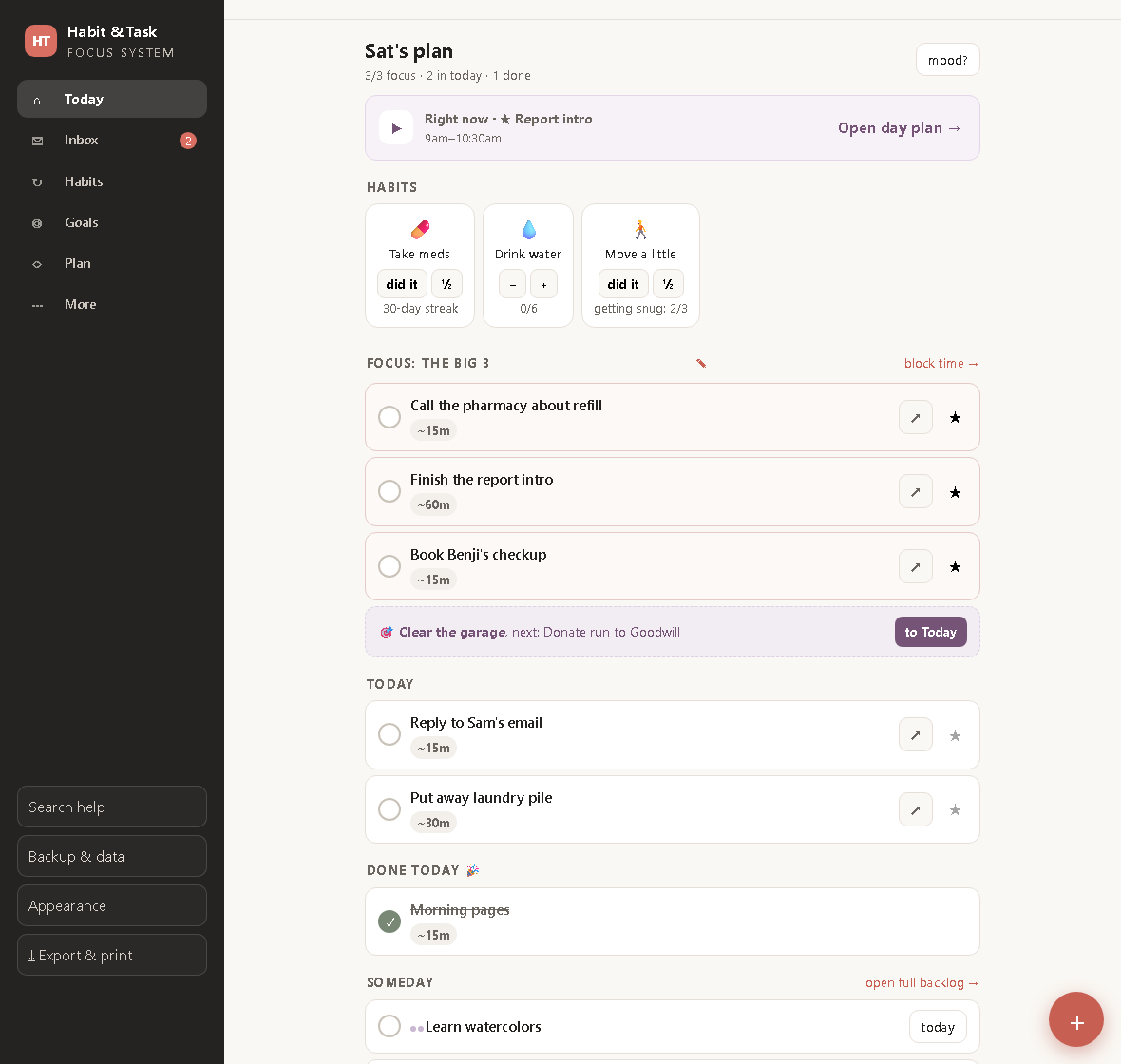
ADHD-Friendly Task Tracking: Fewer Tasks, Clearer Days
Why most to-do apps fail ADHD brains, and a calmer system built on a brain-dump inbox, a hard focus cap of three, and habits that forgive a bad week.
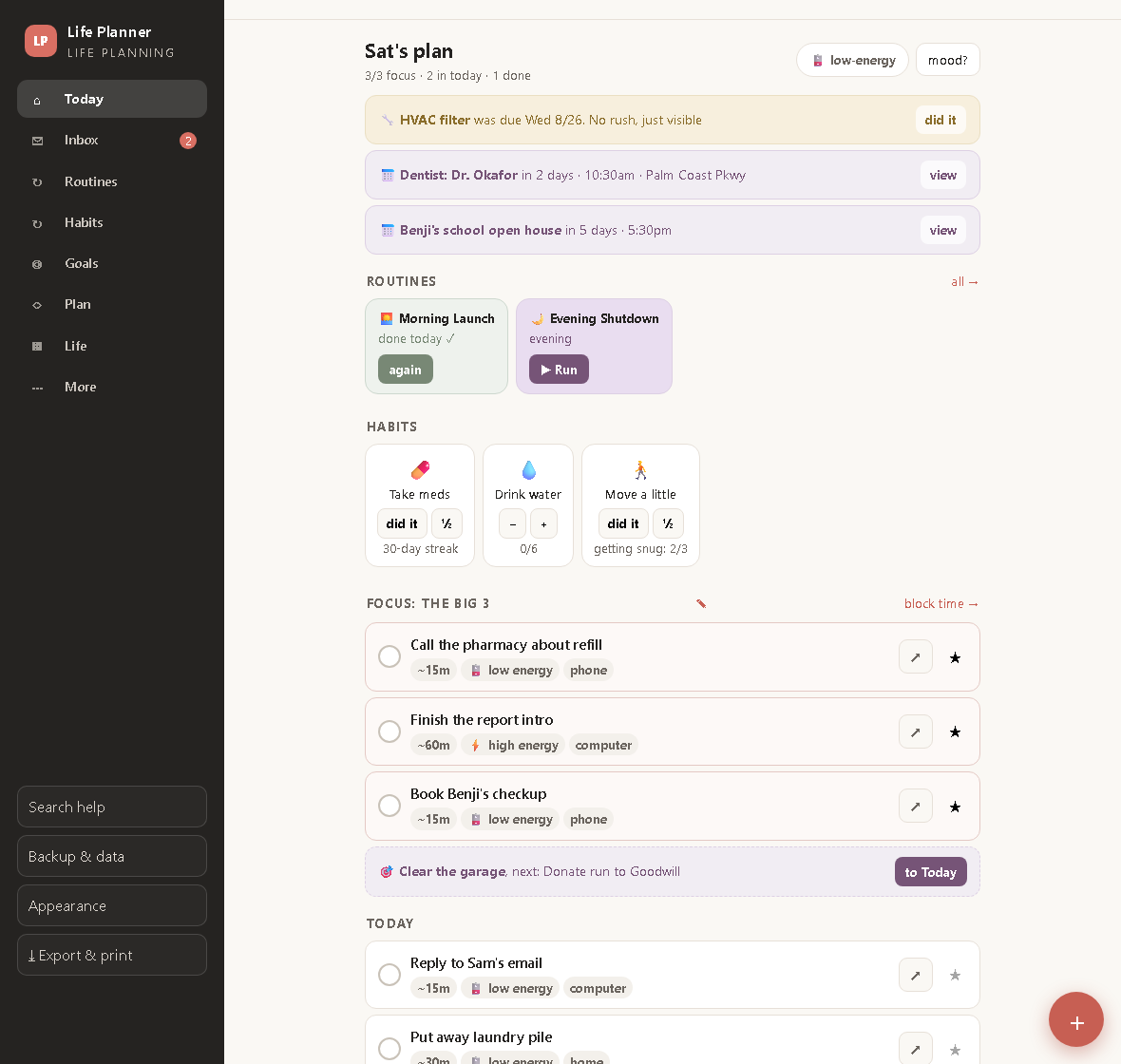
ADHD Routines That Run Themselves: One Step on Screen at a Time
Routine playlists, a low-energy mode, a life-admin binder and an emergency one-pager, so the whole of life gets the same calm treatment as the task list.
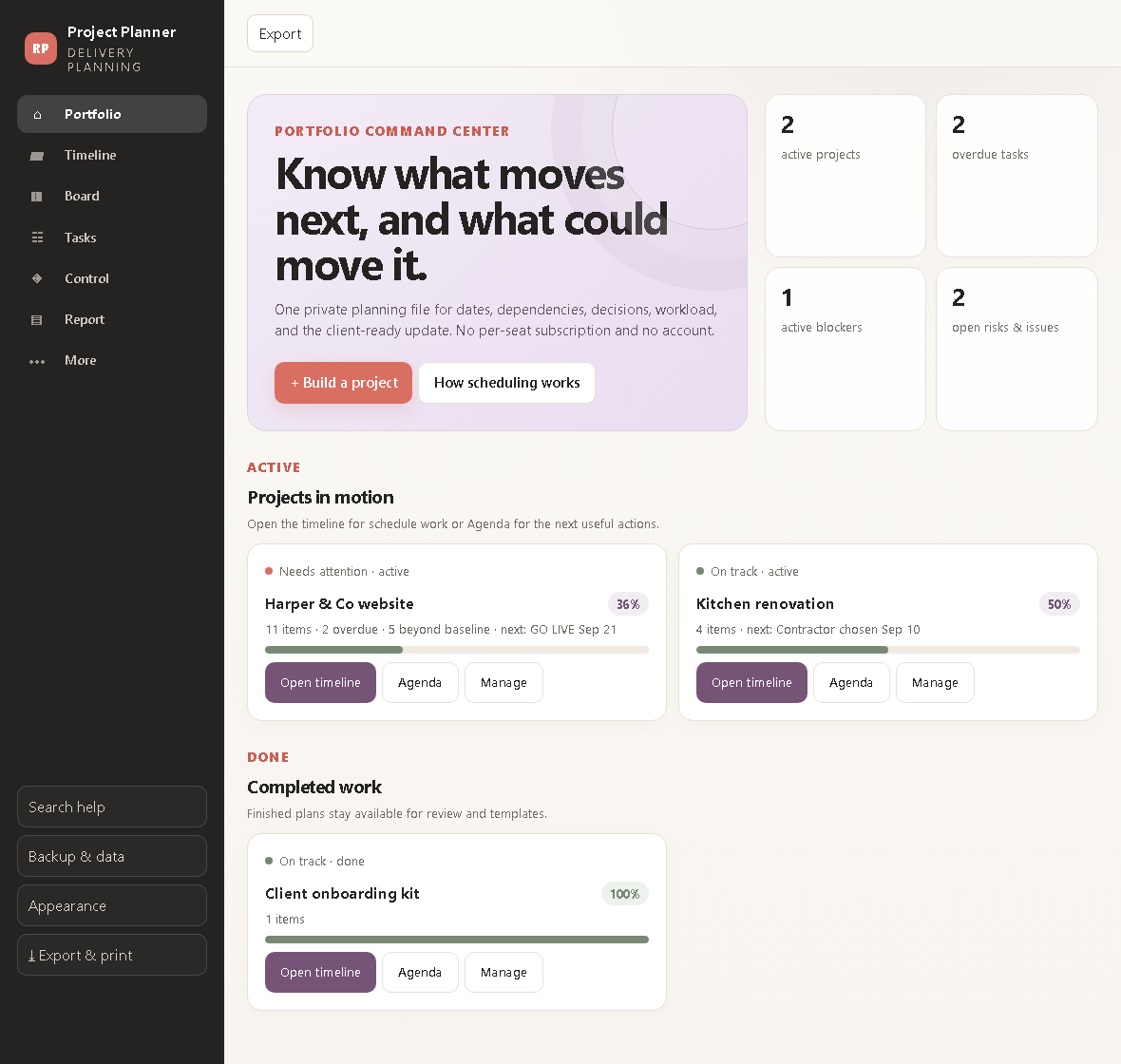
How to Plan a Project Without Losing the Plot
Dependencies, the critical path, a baseline to measure drift against, and a control room for risks and decisions, for one person who has to deliver.